
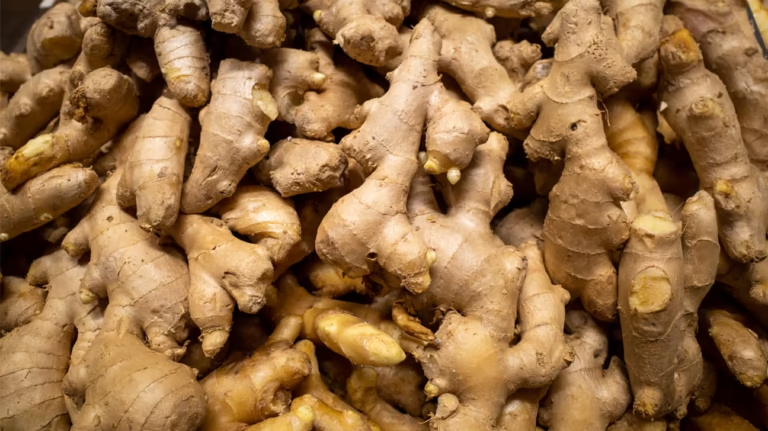
ISLAMABAD, Jan 11 — Pakistan has developed five advanced ginger breeding lines, marking a breakthrough in efforts to establish domestic cultivation after decades of reliance on imports. The achievement is seen as a step toward reducing foreign dependence and building self-sufficiency in a crop that was previously unavailable locally.
Dr Muhammad Iqbal, Principal Scientist and Director at the Vegetable Research Institute of the Ayub Agricultural Research Institute (AARI), Faisalabad, said the new lines are undergoing multi-location trials and have produced encouraging yields. He described the progress as a milestone in Pakistan’s long pursuit of local ginger production.

Trials have identified the Potohar region as particularly suitable for cultivation. Harvests at Dawri Farms in Rawat and Nishtar Farms in Chak Shahzad produced yields comparable to Thailand and higher than India, according to AARI. Additional success has been reported in Azad Jammu and Kashmir and the Bara area.
The breakthrough follows renewed research efforts launched in 2017, including trials under shade structures in Narowal, Gujranwala, and Sialkot. These studies refined production practices and led to the release of AARI Ginger‑2023, a local variety suitable for general cultivation. The institute is also maintaining genotypes sourced from China and Thailand.
To address shortages of planting material, AARI has established a tissue culture laboratory to multiply disease-free plants. Large numbers of seedlings have already been distributed to farmers, replacing market rhizomes that often fail to sprout.
Currently, ginger cultivation is limited to Rawat, Chak Shahzad, Chichawatni, and Jaranwala. Last year marked the first time locally grown ginger entered domestic markets. Awareness campaigns, training programs, and farmer festivals are underway to expand adoption.
The government has launched an expansion drive in the Potohar region, offering cost-sharing support for tunnels, shade nets, seed supply, and drip irrigation. Farmers in Rawalpindi, Jhelum, Chakwal, Talagang, Murree, and Khushab are being invited to participate. Cultivation will be scaled up in phases over three years, with selected farmers committing to grow ginger for at least a decade.
Beyond fresh consumption, researchers are exploring value-added products such as pickles, dried ginger, and powders. Early tests suggest Pakistan’s ginger contains higher gingerol levels, which may enhance taste and shelf life. While the crop requires significant upfront investment, profitability improves from the second year onward, with minimal disease pressure reported so far.