By Sohail Butt Misken
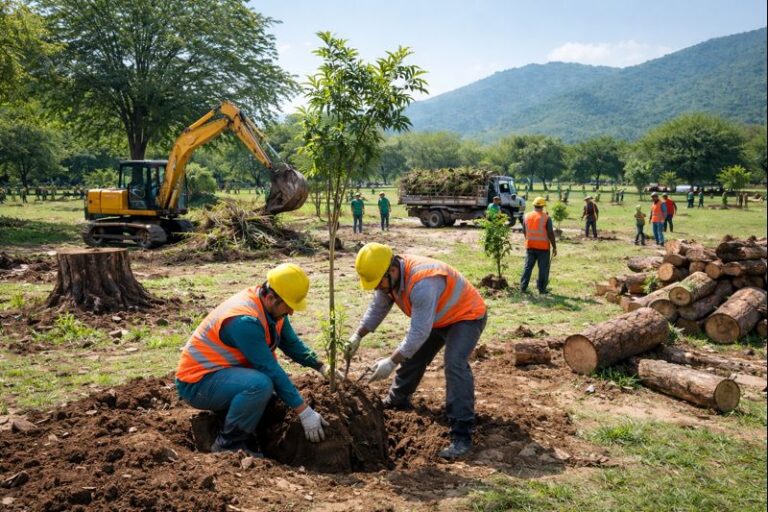
ISLAMABAD: The Government of Pakistan has launched a comprehensive campaign to tackle seasonal pollen allergies in the Islamabad Capital Territory, combining large-scale removal of allergenic trees with an ambitious ecological restoration plan aimed at improving public health and urban sustainability.

The initiative was rolled out in the last quarter of 2024 after the pollen issue was declared a priority at the federal level. A detailed action plan was finalized following a high-level meeting on November 27, 2024, chaired by Dr. Mukhtar Ahmad Malik, Minister of State for National Health Services, Regulations and Coordination. Under the directive, the Capital Development Authority was tasked with implementing the operation and submitting regular progress reports.
Targeted removal of allergenic trees
Working in coordination with the Ministry of National Health Services, Regulations and Coordination, authorities adopted a scientific three-step process to eliminate the invasive paper mulberry tree, known locally for triggering severe pollen allergies. The method involved cutting the trees, uprooting the entire root system, and refilling the soil to prevent regrowth.
Officials said the operation was strictly limited to the allergenic species Broussonetia papyrifera, ensuring that no indigenous or non-allergenic trees were affected. In total, 29,115 paper mulberry trees were removed from various parts of the capital.
Large-scale clearance was carried out in major green spaces, including F-9 Park, where 12,800 trees were removed, and Shakarparian, where 8,700 trees were cleared. Additional removals took place across urban sectors such as G-10, G-11, F-10, F-11, D-12, G-8, G-9, F-8, H-8 and H-9, as well as along Srinagar Highway.
Restoration and replantation strategy
Following the completion of the eradication phase, the campaign has shifted to long-term ecological restoration. Under government policy, three indigenous and environment-friendly trees are to be planted for every allergenic tree removed.
So far, around 40,000 indigenous large trees have been planted at cleared sites, including fruit-bearing and pine species aimed at restoring ecological balance. The effort has been supported through public-private partnerships, with MIRA Power Limited contributing 3,000 saplings and the Beaconhouse School System planting 5,000 trees in the F-9 area.
Authorities have also opened a tender for an additional 18,000 large indigenous trees in collaboration with OGDCL, while 81 acres of land in Shakarparian have been leveled and prepared for plantation. The full restoration process is scheduled to be completed by April 2026.
Decline in pollen-related health cases
Health data indicates a significant improvement following the intervention. According to records from the Allergy Center Islamabad, the number of patients receiving pollen allergy vaccinations has steadily declined since the campaign began.
In 2023, 16,250 patients were vaccinated for pollen and paper mulberry allergies. The figure fell to 14,747 in 2024 and further declined to 12,449 by the end of 2025, reflecting an overall reduction of about 23 percent over two years. The sharpest drop was recorded in the final months of 2025, when monthly vaccination numbers fell by more than half compared to the same period in 2023.
Officials say the results demonstrate that the targeted removal of allergenic trees, combined with systematic replantation, is contributing to cleaner air and improved quality of life for residents of the federal capital.
Also read: Pakistan develops 400 advanced chickpea breeding lines