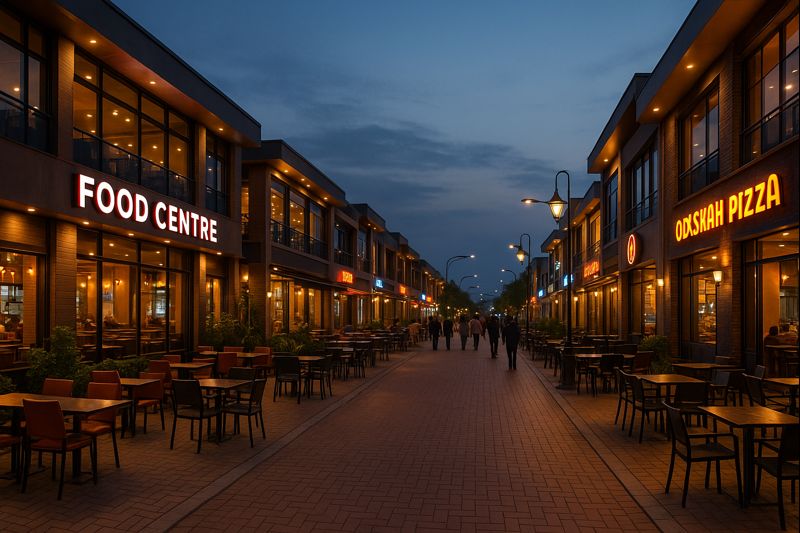
Businessmen and traders operating in Islamabad’s Blue Area have mounted opposition to the Capital Development Authority’s (CDA) proposed food street project, warning that the plan could cripple established businesses, worsen congestion, and create serious security and emergency access risks in what they describe as the city’s most important commercial and corporate hub.
Concerns over lack of stakeholder consultation
Hotel owners, shopkeepers and traders, while talking to APP said the proposed pedestrian-oriented food street planned along the stretch from Parking Plaza to Khyber Plaza was being pushed without any meaningful stakeholder consultation and ignored the unique commercial and demographic character of the area.
Business owners say Blue Area not designed for food street
Hotel owner Suleman Warraich said Blue Area was never designed to host a food street. “This is already the most congested commercial zone in Islamabad, dominated by offices, corporate entities and hospitals. Turning it into a pedestrian food street is simply not feasible,” he said, adding that traffic jams had already been witnessed during trial restrictions and afternoon parking pressures.
Traders recall failed experiences of similar interventions
Iftikhar Shah, a local trader, said the experience of similar interventions elsewhere had been disastrous. Zafar Arshad, who has been running a business in Blue Area for over 25 years, warned that restricting vehicle access would drive customers away. “If cars are not allowed to enter, there will be no clientage. A similar move in Rawalpindi reduced my sales to 30 per cent. If this happens here, survival will become difficult,” he said.
Parking shortages and security risks flagged
Chaudhary Arshad, a shop owner, said limited parking was already hurting businesses. “Most of our customers are high-profile individuals who come with security escorts and multiple vehicles. This initiative will create chaos and eventually ruin our businesses,” he warned.
Hygiene and operational concerns raised by traders
Mukarab Satti, who runs a rent-a-car outlet, termed the project “irrational and out of context.” He said many businesses including clothing stores, pharmacies and shoe shops would suffer due to smoke, waste and hygiene issues associated with food outlets. “This location is not viable under any circumstances. The CDA must revoke the plan,” he said.
Supply chains and daily operations could be disrupted
Shamas Hussain, another trader, said the installation of gates at entry and exit points would halt supplies, logistics and routine mobility of businesses. “CDA should take us on board and halt this project immediately,” he demanded.
Hotels warn of job losses and economic impact
Hotel owner Abdul Ahad said his hotel employed over 160 people and regularly hosted foreigners, government officials, NGO personnel and bankers. “We pay millions in taxes. This project would be a serious blow, potentially leading to unemployment for hundreds,” he said, urging CDA to earmark a more suitable location.
Blue Area’s role as Islamabad’s key commercial artery
Tahir Khan, a local trader, pointed out that Blue Area housed more than 2,000 offices, several hospitals and numerous banks. “How will banks operate? Where will cars be parked? Emergency services and fire brigade access will be blocked,” he said.
Traders suggest alternative location for food street
He suggested the green belt along Fazal-e-Haq Road be developed as a food street instead, warning of pests and rodents if food outlets proliferated in the commercial core. “There are only six restaurants that may benefit; the rest of the businesses will suffer. We condemn and oppose this initiative,” he added.
CDA’s urban revitalisation vision questioned
The food street proposal is part of Capital Development Authority’s broader urban revitalisation drive aimed at promoting tourism, night-time economy and pedestrian-friendly public spaces. CDA officials have previously argued that food streets encourage economic activity and enhance the city’s cultural appeal, citing earlier experiments in other parts of Islamabad.
Past CDA food street experiment cited as failure
However, critics point out that a similar food street initiative previously attempted in Melody failed to sustain footfall and disrupted surrounding businesses.
Traders demand suspension and formal consultation
Traders argue that unlike recreational or residential zones, Blue Area is the city’s largest and most sensitive commercial artery, already operating under severe traffic, parking and security pressures.
With opposition intensifying, traders have demanded CDA for immediate suspension of the project and formal consultations before any further steps are taken. Many have warned that if their concerns are ignored, they will explore legal and protest options to protect what they describe as decades of investment and livelihoods in the capital’s prime business district.
Read related news here: https://greenpost.com.pk/category/business/